AI MLS 3rd world -
Billions
An AI-powered Multiple Listing System (MLS) transforms developing economies. It creates verified property titles, transparent market pricing, and secure avenues for global capital investment.
AI-driven MLS platforms digitize land records and eliminate title fraud. They connect local owners directly with international buyers and accelerate foreign direct investment.
Major Benefits
A comprehensive transformation of the real estate landscape through 14 key pillars of development.
1. Transparency and Fraud Prevention
Blockchain-Enabled Property Records:
Using blockchain for real estate transactions and title recordation ensures a transparent, tamper-proof system where property titles are securely stored. This prevents multiple sales of the same property, significantly reducing fraud.
Clear Ownership Verification:
MLS provides a centralized, easily accessible platform for verifying property ownership. This reduces disputes over land titles; fosters greater trust between buyers and sellers; reduces title fraud.
2. Access to Financial Products
Collateral for Loans:
By having clear, verifiable property ownership records, banks can confidently offer mortgage loans, home equity lines of credit (HELOCs), and other financial products. This makes it easier for citizens to access credit and invest in their future.
Expanding Mortgage Markets:
As property data becomes more reliable, banks can expand mortgage markets, offering new products such as adjustable-rate mortgages and refinancing options.
3. Boosting Foreign Direct Investment (FDI)
Attracting Global Investors:
A reliable, transparent MLS system builds confidence among foreign investors who may be hesitant to invest in unstable or opaque markets. The availability of verifiable property information reduces perceived risks.
Facilitating Cross-Border Transactions:
MLS provides international investors with easy access to property listings and market data, enabling smoother cross-border real estate transactions.
4. Ethical Real Estate Practices
Enforced Code of Ethics:
MLS introduces standardized ethical guidelines for brokers, real estate agents, and sellers. This ensures transparency, professionalism, and ethical conduct.
Consumer Protection:
A compensation fund can be established to reimburse buyers and sellers who are victims of fraud, further promoting trust and confidence.
5. Market Liquidity and Efficiency
Standardization of Contracts:
The system provides standardized contracts for the buying, selling, and renting of properties, minimizing errors and inconsistencies in agreements.
Increased Market Liquidity:
MLS encourages cooperation between agents and brokers, allowing them to share listings and pool their resources. This increases liquidity by matching buyers with sellers easier.
Faster Transactions:
Digital signatures and electronic document management systems enable faster transactions, reducing time to close and improving overall efficiency.
6. Improved Urban Planning and Development
Better Zoning and Planning:
The MLS system provides governments and urban planners with comprehensive data on property ownership, land use, and market trends. This enables informed decision-making for infrastructure and city development.
Sustainable Development:
MLS data can be used to plan eco-friendly infrastructure, housing, and commercial developments, aligning with global sustainability standards.
7. Job Creation and Economic Growth
Supporting Industries:
Introduction of MLS creates opportunities for marketing, home staging, photography, legal services, and home inspections, creating jobs and stimulating GDP growth.
Microservices Development:
Integrate microservices such as tenant screening, property management, and credit reporting, creating new business opportunities and economic diversification.
Increased Tax Revenue:
Clearer records of transactions allow governments to accurately assess real estate taxes, leading to increased revenue for public services.
8. Technology and Innovation
Artificial Intelligence (AI) Integration:
Leverage AI and machine learning to provide personalized property recommendations, predict market trends, and offer pricing insights.
Digitization of Records:
Moving from paper to digital reduces errors, speeds up transactions, and allows for automation (OCR and RPA) to improve efficiency.
Mobile and GPS Technology:
MLS apps can offer GPS-based property boundary verification and real-time access to data, reducing disputes.
9. Legal Protection and Security
Title Insurance:
By standardizing property records, MLS enables title insurance to become more widespread, protecting buyers from legal disputes over ownership.
Tenant Screening & Credit Reporting:
Integrated screening services reduce risks associated with renting, allowing landlords to protect their investments.
10. Social Mobility & Middle-Class Growth
Promoting Home Ownership:
Easier access to reliable property information and financing encourages more people to buy homes, crucial for economic stability.
Affordable Housing Solutions:
By analyzing market data, governments and developers can identify opportunities for affordable housing projects for lower-income groups.
11. Foreign Currency Inflows & Crypto Integration
Real Estate in Cryptocurrency:
MLS can offer real estate in cryptocurrencies, appealing to international buyers who prefer decentralized finance. Properties can be sold using NFTs.
Luxury Real Estate:
MLS helps market luxury properties to foreign investors, increasing foreign currency inflows and service sector jobs.
12. Predictive Analytics & Market Forecasting
Predicting Market Trends:
AI-powered predictive analytics forecast property price appreciation, depreciation, and neighborhood growth potential for long-term decisions.
Heat Maps & Relocation Trends:
Create heat maps showing population shifts and predicting future development locations to balance urban and rural growth.
13. Trust & Confidence in Institutions
Government Accountability:
Fosters trust in government institutions, as citizens see fairness and efficiency in property transactions.
Social Stability:
Increased social mobility and reduced income inequality lead to greater stability and fewer social unrest incidents.
14. Long-Term Economic Benefits
Reduction of Informal Economy:
By formalizing transactions and bringing them into the legal framework, MLS reduces the grey economy and foster long-term growth.
Market Insights
Visualizing the financial landscape and the infrastructure that supports the billionaire-scale MLS opportunity.
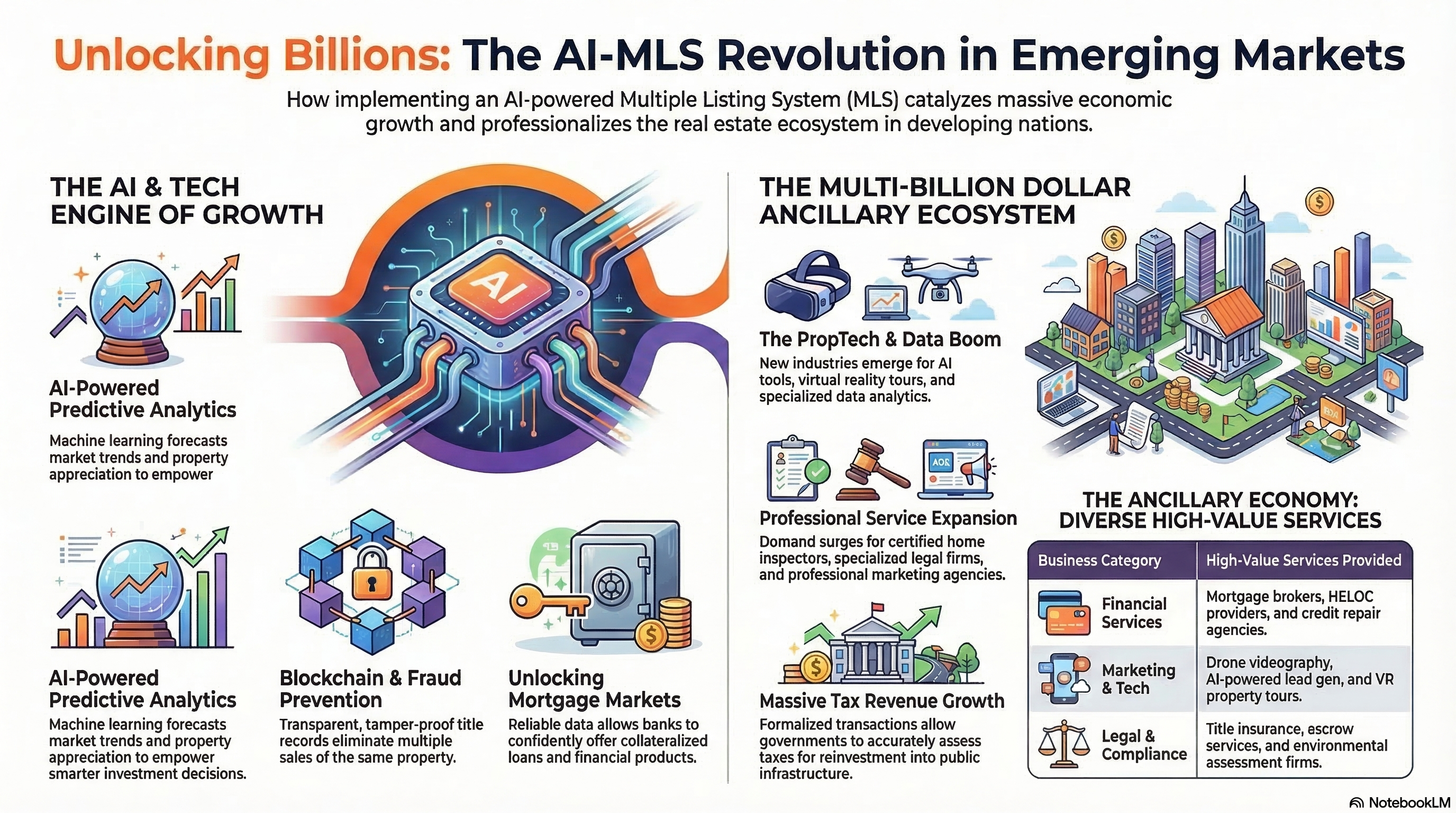
Ancillary Businesses
The ripple effect of MLS implementation creates an entire ecosystem of service industries.
1. Marketing & Advertising
Photography & Drone
Professional photography, drone videography, and 3D virtual tours.
Digital Growth
Social media marketing, SEO, and specialized content creation.
2. Staging & Design
Physical & Virtual
Furniture rental, interior consulting, and virtual 3D staging.
Remodeling
Design packages for new homeowners buying via MLS.
3. Property Management
Residential & Comm
Tenant acquisition, maintenance, and legal compliance.
Vacation Rental
Managing short-term stays, guest bookings, and cleaning.
4. Appraisal & Inspection
Verification
Certified inspections to assess structural integrity and safety.
Valuation
Appraisal services for accurate market value assessment.
5. Legal & Compliance
Legal Expert
Real estate law firms handling contracts and disputes.
Title & Insurance
Title search, title insurance, and escrow services.
6. Mortgage & Financial
Brokers & HELOCs
Navigating home loans and leveraging property equity.
Advisory
Credit repair agencies and tailored financial advisory firms.
7. PropTech & Data
Startups
Software solutions to optimize searches and transactions.
AI & Analytics
Predictive analytics on trends and buyer behavior.
8. Education & Certs
Schools
Training institutions for professional real estate standards.
E-Learning
Continuous education and mentorship programs for agents.
9. Home Improvement
Renovation
General contractors and handyman services for listings.
Green Energy
Energy audits and green building certifications.
10. Insurance
Protection
Comprehensive home insurance for fire, theft, and natural disasters.
11. Moving & Relocation
Logistics
Packing, moving, and storage services for transitions.
Expatriate
Relocation help for foreign buyers and cultural orientation.
12. Interior & Décor
Bespoke
Custom furniture designers and luxury interior design firms.
13. Signage & Branding
Physical Ads
Yard signs, banners, and vehicle wraps for listings.
Branding
Custom brochures, business cards, and promotional products.
14. Development & Construction
Urban Growth
Real estate development firms using MLS data insights.
Engineering
Major construction services for infrastructure and urban expansion.
15. Tenant & Landlord
Screening
Background and credit reports for rental properties.
Software
Platforms to help landlords manage multiple rental units.
16. Blockchain Payments
Crypto Real Estate
Secure blockchain processing for international buyers.
Specialized Brokers
Brokers managing transactions via decentralized finance.
17. VR & AR Solutions
Virtual Tours
Creating immersive VR property tours for remote buyers.
Design AR
Visualizing furniture and renovation ideas within a space.
Transforming the Real Estate Landscape & Beyond
A fully developed MLS is much more than a tool for listing properties—it creates an entire ecosystem of interconnected businesses that support and enhance the real estate market. The implementation of MLS in a developing country can transform the economy, fostering a more transparent, efficient, and dynamic future.
FAQ
Common questions about AI MLS infrastructure, blockchain registries, real estate tokenization, and emerging market PropTech.
Interested in deploying nationwide MLS software or partnering on our finder's fee program? Contact our team directly.